|
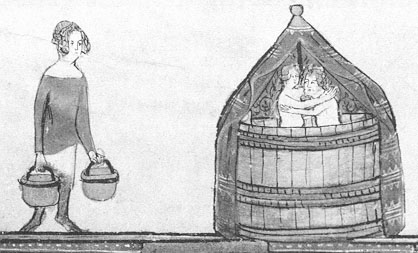
One tends to think of the Middle Ages and Renaissance as a period in which people never bathed – yet this is not the case. Not only did our ancestors bathe (and probably a bit more often than we give them credit for), but this became a sort of recreational activity in some settings.
There are also many images, such as those depicting the Nativity or the Birth of Mary, which show babies bathed in shallow washtubs.
Some articles on the subject:
A Short History of Bathing before 1601; Tubbed and Scrubbed;
Bedrooms, Bathing, and what did they do without indoor plumbing?; Cleanliness: Bathing and cleansing of the medieval woman; Medieval Bathing;
and the Florilegium's notes on Roman hygiene, medieval hygiene, and bathing.
Bathing and Personal Hygiene in Ancient India includes several illustrations as well as an abstract on bathing in Karnataka.
What to wear to the bathhouse? Read about The Bohemian Bathhouse Babes from the Wenceslaus Bible and 14th Century Shift: Bohemian Bathhouse Babes Come to Life.
- A Feast For the Eyes includes a few (mostly undated) pictures of baths: A large stew; A couple enjoying a stew; Bath and board; Enjoying a stew.
- Herr Jakob von Warte, Manesse Codex (UBH Cod. Pal. germ. 848, fol. 46v), 1300-1330
- A girl bathing (possibly St. Anne and the Virgin), Luttrell Psalter (British Library MS Add. 42130, fol. 97v), c. 1325-1335
- Bathing couple from the Romance of Alexander (Bodley 264), c. 1338-44
- Nero orders the death of Seneca, Roman de la Rose (Bibl. Sainte-Geneviève MS 1126, fol. 044), c. 1350-1360
The bathes weren thanne araied, With herbes tempred and assaied, And Jason was unarmed sone And dede as it befell to done: Into his bath he wente anon And wyssh him clene as eny bon; He tok a sopp, and oute he cam, And on his beste aray he nam, And kempde his hed, whan he was clad, And goth him forth al merie and glad Riht strawht into the kinges halle. Confessio Amantis,
Liber Quintus, Part 2,
ll. 3801-3811, c. 1393 - The Wenceslas Bible, late 14th century
See Wikimedia’s files from the Wenceslaus Bible, and Muckley 1386 Women’s Clothing: Underwear
- Another "bathhouse babe" in an astronomical text (ÖNB 2352, fol. fol. 34v), c. 1392-1394
- Another "bathhouse babe" in the Epistles of Paul (ÖNB 2789, fol. 1r), c. 1395-1400
- More "bathhouse babes" here and here in a commentary on Ptolemy (ÖNB 2271, fol. 1r), c. 1395-1405
- Bathing from the Tacuinum Sanitatis (BNF Nouvelle acquisition latine 1673, fol. 97), c. 1390-1400
- De balneis puteolanis (PML G.74), c. 1395-1405; the text (written in 1220) compares the medical benefits of different baths and spa waters around the Bay of Pozzuoli, and this manuscript includes over 30 illustrations of the baths.
- First Folio of the Golden Bull of Charles IV, 1400
- Mary in bath in a book of hours c. 1400-1410 (The Hague, KB, 76 F 21, fol. 15r)
- Helmichilde forces Rosemonde to die with him, Les cas des nobles hommes et femmes (Bibl. Sainte-Geneviève MS 1128, fol. 309), c. 1413-1420
- Bathsheba bathing, the Hours of Charlotte of Savoy (PML M.1004, fol. 78r), c. 1420-1425
- Guillaume de Digulleville repents, The pilgrimage of human life (BNF Fr. 376, fol. 73v), second quarter of the 15th century
- The assassination of Constant II (fol. 246v) and the death of Rosemonde and Hmichilde (fol. 347v), Facta et dicta memorabilia (BNF Fr. 229), c. 1435-1440
- Seneca and Pompeia Paulina are bled to death, De mulieribus claris (British Library Royal 16 G V, fol. 110), c. 1440
- Bath house, The Book of Valerius Maximus (BNF Arsenal 5196, fol. 372), 15th century
If your lord wishes to bathe and wash his body clean, hang sheets round the roof, every one full of flowers and sweet green herbs, and have five or six sponges to sit or lean upon, and see that you have one big sponge to sit upon, and a sheet over so that he may bathe there for a while, and have a sponge also for his feet, if there be any to spare, and always be careful that the door is shut. Have a basin full of hot fresh herbs and wash his body with a soft sponge, rinse him with fair warm rose-water, and throw it over him; then let him go to bed; but see that the bed be sweet and nice; and first put on his socks and slippers that he may go near the fire and stand on his foot-sheet, wipe him dry with a clean cloth, and take him to bed to cure his troubles. How the Wise Man Taught His Son
Lambeth 853, fol. 186 - Sergius Orata in his bath, Facta et dicta memorabilia (BNF Fr. 287, fol. 181), third quarter of the 15th century
- Raimondin discovers Melusine's secret, Melusine (BNF Fr. 24383, fol. 19), second half of the 15th century
- Medea rejuvinates Jason, Ovid's Metamorphoses (BNF Fr. 137, fol. 91), second half of the 15th century
- A woman is spied-on while bathing, Roman de Girart de Nevers (Bibliothèque Royale Albert ler MS 73, fol. 12r), c. 1460
- May, Biblia Pauperum (ÖNB 3085, fol. 4r), 1475
- Pagan customs: men and women at a meal and in bath, The City of God (The Hague, MMW, 10 A 11, fol. 69v), c. 1475-1480
- Venus and her children, and a bathhouse, the Wolfegg Housebook, c. 1475-1485
- St. Elizabeth of Thuringia bathes the lepers in the Elizabeth Altarpiece from the Church of St. Agidius at Bardejov, c. 1480-1500; note the soap, piggin, and comb on a stool by the tub
- Bathsheba by Hans Memling, 1485
- Nero at Seneca's suicide, Le Roman de la Rose (British Library Harley 4425, fol. 59v), c. 1490-1500
- Oedipus and Jocasta, Metamorphoses (British Library IC.41148, LI), 1494
- Bathing scene, Biblia Pauperum (ÖNB 3085, fol. 34v), 1495
- St. Elizabeth of Thuringia bathes the lepers in an altarpiece from Laufen, c. 1495-1505
- Two frescoes by Albrecht Altdorfer, c. 1530-1540: A man and woman bathe together, and a woman bathes a man
- The Bathhouse-Caretaker, Eygentliche Beschreibung aller Stände auf Erden, 1568
- The Baths at Pozzuoli by Girolamo Macchietti, c. 1570-1572
- Portrait of a Woman (Diane de Poitiers) by Francois Clouet, 1571
- "Of Baths and Hot Wells," Chapter XXIII in Harrison's Description of England, 1577
|