|
More combs can be seen at Toiletries Through the Ages, including an Egyptian wooden double-sided comb, a Scythian gold comb, a medieval composite double-sided bone comb, and an ivory double-sided comb.
Also check out reenactors’ webpages about creating period-style combs, and other related links, in the Antler Combs section of the Atlantian A&S Links.
Wooden combs
- Double-sided wooden comb, Gallo-Roman, 1st-4th centuries
- Double-sided comb (Met 31.8.39) made in Kharga Oasis, Byzantine Egypt, 4th century
- Double-sided comb (Met 30.112.12), 7th-8th century Egypt
- Comb with teeth at each end (Met 1999.153.14), 8th century, Caucasus region
- Boxwood comb with poker worked ornaments, Colletire, France, early 11th century
- Undecorated medieval wooden comb (MoL NN18417)
- Fragment of a double-sided one-piece wooden comb (MoL A4929), London, 15th century
- 15th century birchwood comb
- 15th century boxwood comb (Cleveland 1951.452) inscribed “mon avis” and “pour bien”
- 15th century French wooden comb from A Brief Description of Some Medieval French Woodworking at the Muse National du Moyen Age
- Comb in carved wood, 15th century Germany (also here)
- Comb with ivory and ebony inlay (Met 61.30), North Italian, 15th century
- Wooden comb, 15th-16th century
- Boxwood comb inlaid with bone and decorated with red and green silk (Met 1982.357), 15th-16th century, possibly French
- Two wooden combs carved from boxwood (one with ivory[?] inlays), northern France, c. 1500; more photos here and here
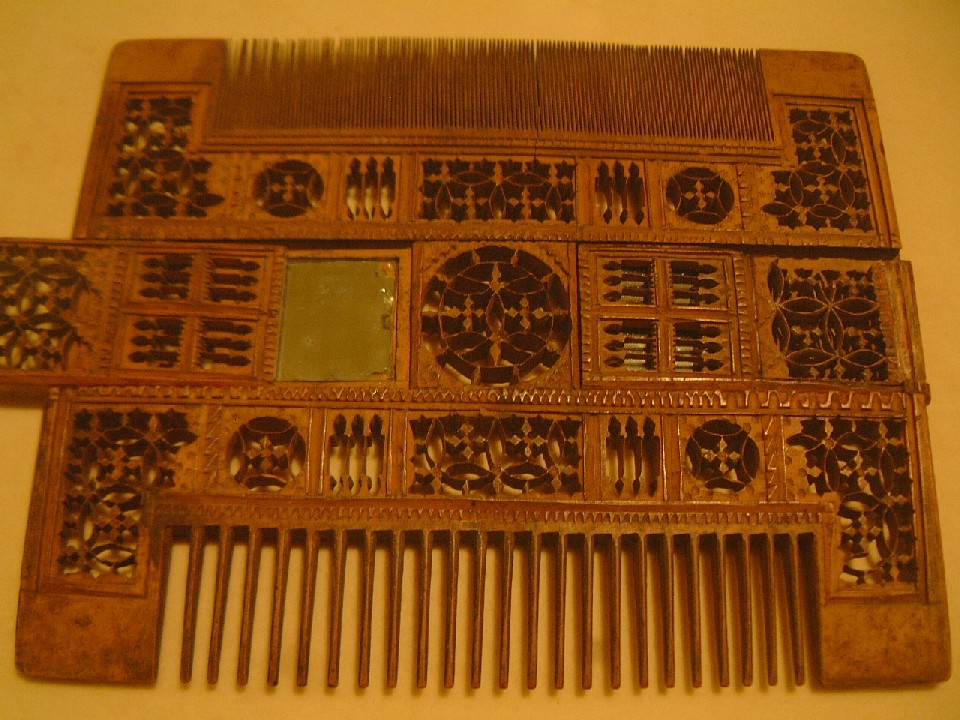
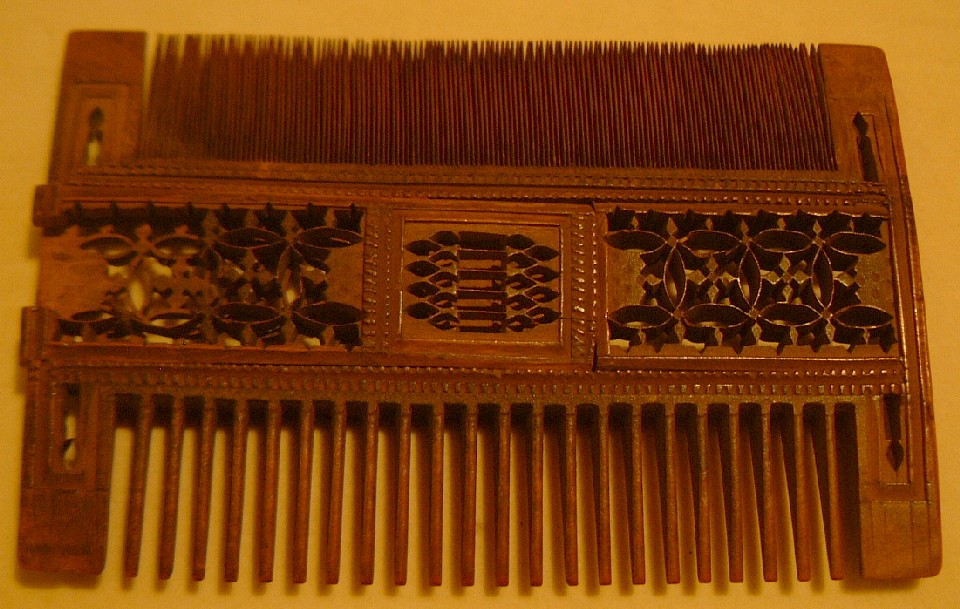
- Boxwood folding comb (Met 1985.200) probably made in Tyrol, c. 1500
- A boxwood comb made in northern France c. 1500; see p. 25 of this catalog
- Plain double-sided comb (MoL A3159), London, 16th century
- Combs from the Mary Rose (1545), including a comb with a pouch
- Boxwood comb (Met 64.101.1593) made in France in the third quarter of the 16th century
Ivory combs
- Fragment of an ivory comb (Met 2000.284.8), Afghanistan or West India, 1st-3rd century
- Ivory comb (V&A IM.21-1937), India, 2nd century
- Ivory comb of Modestina (British Museum GR 1904.2-4.1168), Roman, 3rd-4th centuries
- Ivory liturgical comb (called "St. Berthuin's comb"), 6th century
- The so-called Comb of Theodelinda, ivory with silver and sapphires, made in Lombardy in the 7th century
- An ivory comb carved with a sitting figure and three standing figures, 7th century
- Double-sided comb (Met 17.191.258) made in northern France, 7th century
- Ivory liturgical comb with a design of two young women's heads, 8th century
- Ivory liturgical comb (called “St. Hubert’s comb”), 8th century
- Ivory comb depicting either Sampson or David with a lion (Louvre 1806), made in Metz around 875-900
- The so-called Comb of St. Heribert, c. 851-900
- Ivory comb with stylized horses, 10th century
- The comb of St. Ulrich, 11th century?
- Liturgical comb, ivory, 11th century
- Liturgical comb (reliquary of St. Hadelin), Meuse river valley, 11th-12th century
- Liturgical ivory comb (British Museum M&ME 1856,6-23,29), late 11th century, found in England or Wales
- An ivory comb, possibly made in southern Italy, c. 1080-1120
- Saint Albans liturgical comb, 1120
- The beard-comb of the Holy Roman Emperor, ivory with gold and precious stones, 12th century
- English liturgical comb (Met 1988.279) decorated with scenes from the life and martyrdom of Thomas Becket, ivory, ca. 1200-1210
- Fragment of an ivory comb with the legend of St. Clemens, c. 1201-1215
- Ivory comb with two birds in circles, southern Italy, 13th century
- Ivory double comb (V&A A.560-1910) with lovers in a garden, Paris, second quarter of the 14th century
- Ivory double-comb carved with the Adoration of the Magi and Annunciation, upper Italy, second half of the 14th century
- Ivory comb with dancers (?) at a fountain, northern Italian, late 14th century or early 15th century
- Ivory comb with scenes from legends (a joust on one side, two ladies on the other), France, beginning of the 15th century
- Incomplete double-sided one-piece comb of elephant ivory (York SF01091) found in York dating to the 15th century
- Fragment of a double-sided ivory comb (MoL A4730), London, 15th century
- Ivory comb with the adoration of the Magi, 15th century
- Unfinished ivory comb, intended to be double-sided (MoL 97.42), medieval London
- Ivory double comb with secular scenes (Walters 71.266), France, c. 1490-1500
- Woman’s comb (Met 17.190.245) made in France or Italy in the 15th or 16th century, ivory with polychromy and gilding
- Comb (Met 17.190.262) made in northern France in the late 15th or early 16th century
- Ivory comb with the story of Bathsheba on one side and the Knight and the Three Graces on the other, Germany, beginning of the 16th century
- Ivory comb with carved openwork with small figures and a bust between medallions, grotesques, and gryphons; France, beginning of the 16th century
- Comb with scenes from the story of Joseph (Met 11.93.13), mid-16th century, probably Flemish
- Gold comb with Scythians in battle, 5th-4th centuries BC
- Jade and gold comb (Met 2004.322), c. 25-220
- Bone comb from South Shields, 2nd-4th century
- Antler bone comb from Roman-occupied Britain
- Bone comb, 4th-5th centuries
- Double-sided combs made from antler from Anglian York
- Horn and bronze comb, 5th century
- Bone combs from the 5th-7th centuries
- Bone combs, Frankish/Merovingian, 5th-8th centuries; another Frankish/Merovingian bone comb
- Bone combs and case, 6th-8th centuries
Saxon combs
- Bone and antler comb (MoL HAM90[287]<39>) from an early Saxon settlement in Hammersmith, 6th century
- Eighth century ivory comb found in an Anglo-Saxon house
- Single-sided composite bone combs and related fragments at the Museum of London:
(MoL ROP95[972]<7>),
A3901,
4003,
4005,
4010,
A14723,
A14724,
14727,
A16884,
A28151
- Antler combs in at the Museum of London:
O2015,
4009,
A7346
- Comb from Anglo-Saxon Canterbury, described thus: "Made from animal bone with iron rivets to secure side plates. The use of recycled animal bone was very common in the past. Decorated with 'ring and dot' design."
- Two late Saxon combs from Longmarket
- Bone comb, 8th-10th centuries
- Frankish combs from Niederbreisig, Germany at the Met:
17.193.37,
17.193.53,
17.193.86,
17.193.95,
17.193.115,
17.193.123,
17.193.148,
17.193.185,
17.193.215,
17.193.224,
17.193.226,
17.193.238,
17.193.255,
17.193.267,
17.193.275,
17.193.288,
17.193.298,
17.193.306,
17.193.322
Viking-era combs
- Antler comb with matching case, 9th-10th century, from York
- Composite combs:
SHM 5208:573,
SHM 5208:574,
SHM 7582,
SHM 9549,
SHM 25501,
SHM 28047
- Double combs: SHM 6209
- Composite single comb, Swedish, 9th-11th century
- Viking combs and other tools for grooming
- Photos of combs at the Historisk museum in Oslo
- Several Viking bone and antler combs at the Hunterian, including
B.1914.492/1,
B.1914.492/2,
B.1914.492/3,
B.1914.494,
B.1914.495,
B.1914.496,
B.1914.792,
B.1914.845
- Gilded comb top, Liao dynasty China, 10th century
- Delousing comb and scissors found on the Serçe Limani shipwreck, 1020s; see also this discussion in Serçe Limani, An Eleventh-Century Shipwreck (Vol. 1)
- Antler tooth-plate fragment from a composite comb found in York dating to the 11th century
- Gilt liturgical double-comb, 11th century
- Double one-piece comb made of antler, Swedish, 11th-12th century
- Single-sided composite bone comb (MoL 20246), London, 11th-12th century
- Saxo-Norman single-sided composite bone comb (MoL 12741) with antler side plates
- Bone comb, 1100-1220, Finland
- Double-sided composite comb (MoL 4007) in bone, with circle and dot pattern, medieval London
- The comb of the Mother of God, from the cloister of the Sisters of the Holy Ghost, c. 1101-1150
- Viking-age or early medieval double comb found at Broby bro
- Zodiac: the sign of the Ram, Georgius Zothorus' Liber astrologiae (BNF Lat. 7330, fol. 7), 2nd quarter of the 13th century
- Bone combs, 12th-13th century; another bone comb, 12th-13th century
- Fragment of a double-sided composite bone comb (MoL 18668), London, 13th century
- Fragment of a French ivory comb with religious scenes, 1250-1300
- Composite double comb, Swedish, 13th-15th century
- Fragment of a double-sided horn comb (MoL 4392)
- Hell, a bible (BNF Fr. 13096, fol. 86v), 1313
- Ages of Man: Youth combs his hair, the De Lisle Hours (PML G.50, fol. 29r), 1316-1331
- Mural cycle showing the processing of silk and flax at the Kanonikerhaus in Constance, Germany, c. 1320: one woman combs another woman's hair
She hadde bath, sche hadde reste, And was arraied to the beste. Bot with no craft of combes brode Thei myhte hire hore lockes schode, And sche ne wolde noght be schore For no conseil, and thei therfore, With such atyr as tho was used, Ordeinen that it was excused, And hid so crafteliche aboute, That noman myhte sen hem oute. Confessio Amantis,
Incipit Liber Primus: Part 1,
ll. 1747-1756 - A dog holds a comb (fol. 101v) and a monkey holds a comb & mirror (fol. 117v), the DuBois Hours (PML M.700), c. 1325-1330
- The Luttrell Psalter (Brit. Lib. Add. 42130), c. 1325-1335: In this illustration of a servant dressing a lady's hair (fol. 63r), there is a double-sided comb. A similar comb is held by a mermaid in fol. 70v.
- Lover speaks to Idleness, who combs her hair, Roman de la Rose (PML M.324, fol. 5v), c. 1350
- Susannah and the elders, Bible historiale (BNF Fr. 159, fol. 238), 14th-15th century
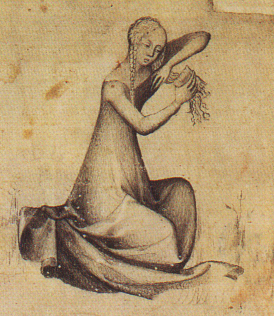
- A woman combs her hair in a pen-and-ink sketch c. 1400
- A woman (the constellation Virgo?) combs her hair, astrological treatises (PML M.785, fol. 4v), 1400-1403
- Wooden liturgical comb, 15th century
- Ivory comb with painted carvings (the Fountain of Youth), Upper Rhine, c. 1450
- Mermaid, Les Fais et les Dis des Romains et de autres gens (British Library Harley 4372, fol. 79v), c. 1460-1487
- Detail from St. Elizabeth of Thuringia bathing the lepers in the Elizabeth Altarpiece from the Church of St. Agidius at Bardejov, c. 1480-1500
- Ivory comb with scenes from the story of David and Goliath, 16th century
- Oneida Iroquois antler comb, c. 1500-1550
- The Comb-Maker, Das Ständebuch, 1568
- Martha and Mary Magdalene by Caravaggio, c. 1598
- Portrait of Elizabeth Vernon, Countess of Southampton, c. 1600
- Allegory of Vanity by Jan Miense Molenaer, 1633
Sites where one can purchase medieval-style combs of different styles: |