|
An interesting article on related vehicles in Antiquity: Roman Traction Systems.
- The Oseberg cart, and wagons on the Oseberg Tapestry, 9th century; for construction, see The Oseberg Cart.
- The Maciejowski Bible, 1250
Joseph is honored (fol. 5v): A wagon drawn by two horses.
Barak attacks Sisera (fol. 12r): A wagon drawn by two horses.
The Ark comes to Beth-Shemesh (fol. 21v): A wagon drawn by two cows.
- Jacob's wagon, Bible moralisée (Bodl. 270b, fol. 32r), mid-13th century
- A wagon (fol. 18v), Jacob in a wagon (fol. 23r), Jaocob's body in a shroud on a wagon (fol. 26v), psalter (Douce 48), third quarter of the 13th century
- 14th century Bible historiale (BNF Fr. 152), fols. 71 and fol. 128v
- Apes with a covered wagon, psalter (Douce 6, fol. 200v), c. 1320-1330
- The Luttrell Psalter (Brit. Lib. Add. 42130), c. 1325-1340: a farm cart (fol. 162r), a hay-cart (fol. 173v), and a travelling coach (covered wagon) for royal ladies (fol. 181v)
- Transporting the wounded Arthur by carriage, Spieghel Historiael (The Hague, KB, KA 20, fol. 163v), c. 1325-1335
- A medieval cart for transporting a winebarrel in an edition of Brunetto Latini's Book of the Treasure (BNF Fr 571, fol. 66v), ca. 1326
- Ponce de Froitmantel (p. 468) and Avice de Barneville (p. 489), Life and Miracles of Saint Louis (BNF Fr. 5716), c. 1330-1340
- The Romance of Alexander (Bodl. 264), 1338-1344, fols. 42v, 83v, 109r, and 152v
- Covered wagon drawn by two horses, psalter (Douce 131, fol. 43r), c. 1340
- Scene from a legend, Weltchronik (PML M.769, fol. 305v), c. 1360
- Camouflaged hunter in a horse-drawn cart, Livre de la chasse (PML M.1044, fol. 103r), c. 1406-1407
- Tres Riches Heures, 1412-16
August: A wagon loaded with hay in the far background.
September: A pair of oxen draw a cart, laden with grapes that have been harvested.
- A covered wagon carrying passengers in a detail from a fresco at Castello della Manta, c. 1420
- Border (base-de-page), The Book of Hours of Margaret of Orleans (BNF Latin 1156 B, fol. 158v), c. 1426
- Cybele, goddess of the Earth, from Livre des checs amoureux, 15th century
- Elijah's ascension in a Bible historiale (BNF Fr. 9, fol. 168v), 15th century
- De casibus (BNF Fr. 226), 15th century: Similar wagons with canopy-like covers in images of triumphs in fols. 143v and 219; a plainer (and more open) wooden wagon carries the dying Darius III in fol. 104v; and simple carts (with barred sides) are employed in the torture of Mettius Fufetius in fol. 60v.
- The battle between the Romans and the Latins (fol. 77v), Ad urbe condita (BNF Fr. 33, fol. 77v), mid-15th century
- Encampment in the Book of the Conquests and Deeds of Alexander (Musée des Beaux-Arts de la Ville de Paris L.Dut.456, fol. 64v), mid-15th century
- September in the Hours of Adélaïde de Savoie (Musée Conde 76, fol. 9v), c. 1460-1465
- Duke Bueve d'Aigremont finding his wife, Renaut de Montauban (NF Fr. 5072, fol. 21v), c. 1462-1470
- Golden wagons on fols. 6v and 21v, Renaud de Montauban (BNF Arsenal 5072), c. 1468-1470
- A hay-wagon, De re rustica (PML M.139, fol. 2r), 1469
- A covered wagon, Cas des nobles hommes et femmes malheureux (PML G.35, fol. 79v), c. 1480
- Wagon-drivers (including freight-haulers) in the Mendel Hausbuch:
Leupolt Karrenman (c. 1425),
Cuntz Wagenmann (c. 1425),
Grünwald Karrenman (c. 1425),
Hans Awracher (1435),
Hans Preunlein (1464),
Hans Schultheis (1494),
Heintz Trechßel (1503),
Hanß Müllner genannt Heyliger gaist (1554),
Stephan Krapff (1554),
Andres Mulner (1570)
- Caesar in a carriage, Bellum Gallicum (British Library Royal 16 G VIII), 1473-1476
- Tarquin the Elder and his wife Tanaquil sit together in their carriage in Valerius Maximus' Facta et dicta memorabilia (The Hague, KB, 66 B 13, fol. 180v), c. 1475
- Ermengarda in a carriage, Les anciennes chroniques de Flandres (British Library Royal 16 F III, fol. 11), last quarter of the 15th century
- Baggage train for an army and an army camp, the Wolfegg Housebook, 1475-1485
- September, The Grimani Breviary, c. 1490-1510
- Mars (fol. 36) and Cybele (fol. 147v), Êchecs amoreux (BNF Fr. 143), c. 1496-1498
- Bachus and Ariadne in a wagon drawn by snakes, De re rustica (British Library Harley 2702, fol. 2), last quarter of the 15th century or first quarter of the 16th century
- A horse-drawn wagon transporting a barrel, book of hours (Douce 276, fol. 122r), beginning of the 16th century
- The Haywain by Hieronymus Bosch, 1500-02
- Escape of St. Cantius, St. Cantianus, and Cantianilla, c. 1505-1515; wagon wheel
- Ydonia on a journey in the Chronicle of Flanders (The Hague, KB, 132 A 13, fol. 1r)
- Detail from The Mockery of Job in an altarpiece from Innsbruck, c. 1515-1525
- Assistance in a nobleman’s wagon-accident (detail) from the Great Altar of the Miracles of Mary at Graz, c. 1518-1522
- July (fol. 4v) and August (fol. 5r), a book of hours (PML M.307), c. 1520
- Covered wagon in the April section of the Augsburger Monatsbilder, 1520s
- Upper section of a Prunkwagen, c. 1527
- Oxen pulling a wagon in fol. 11r in the Hennessy Book of Hours, c. 1530-1540
- July (a hay-cart), the Golf Book (Brit. Lib. Add. 24098, fol. 25r), c. 1540
- Hanrich Krustain, Landauer Hausbuch (Amb. 279.2, fol. 29v), 1542
- Ecce Homo by the Brunswick Monogrammist, c. 1545
- Market Scene by Pieter Aertsen, 1550
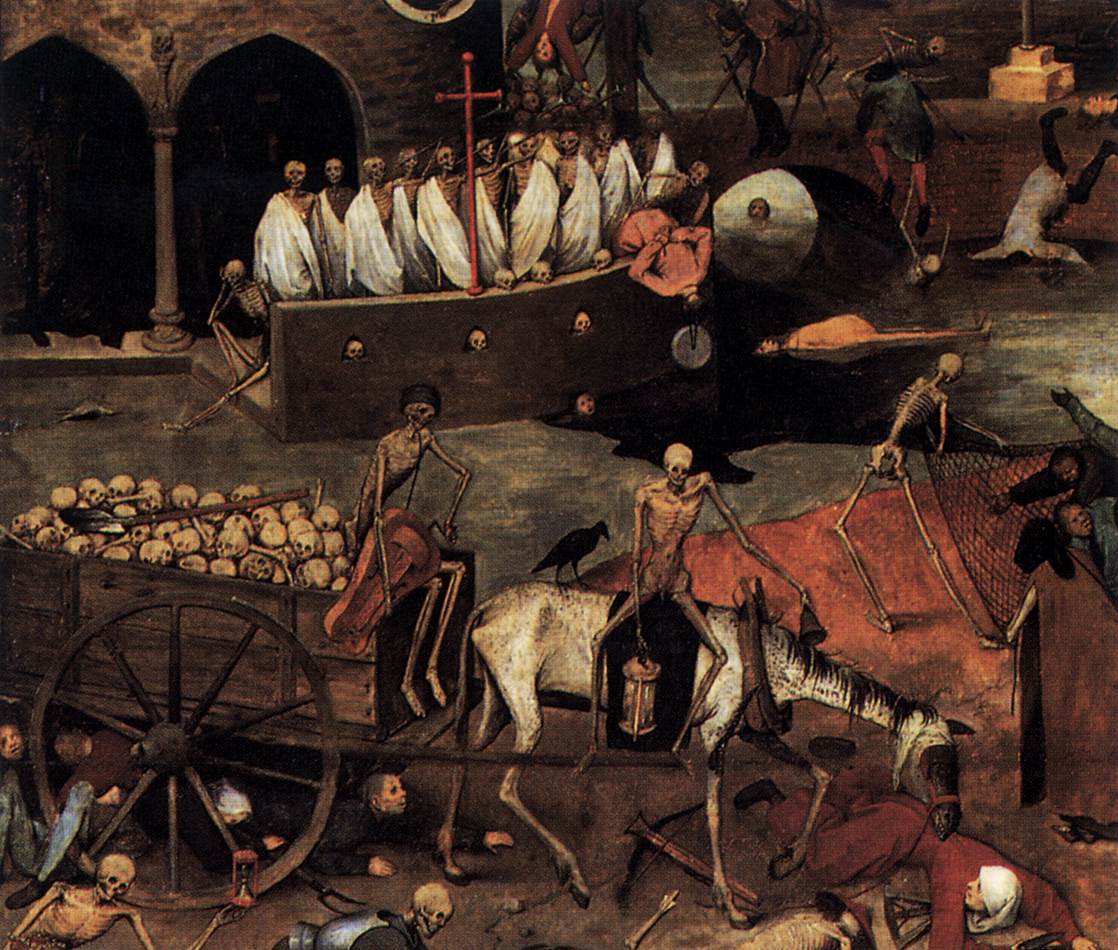
- Detail from The Triumph of Death by Pieter Bruegel the Elder, c. 1562
- The Census at Bethlehem by Pieter Bruegel the Elder, 1566
- The Wagon-Wright, Das Ständebuch, 1568
- Village Feast by Joachim Beuckelaer
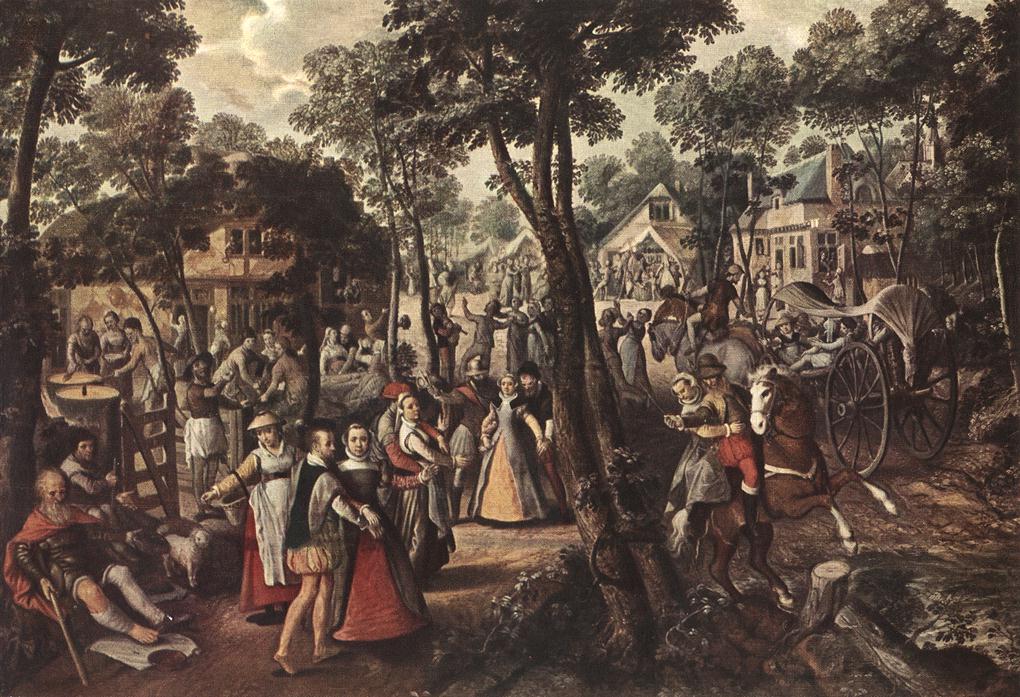
- Village Feast (Annual Fair) by Hans Bol
- Village Feast by Gillis Mostaert
- Carriage carrying several woman passengers, drawn by two horses, Album Amicorum of Jan van der Deck (Rawl. B. 21, fol. 46v), after 1592
- Oval miniature showing a pair of horses, with driver, pulling a covered carriage containing a gentleman and a lady wearing a mask, Discours à Lesdiguiàres (British Library Harley 5256, fol. 22), 1597
- The Battle of Carnival and Lent by Pieter Brueghel the Younger
- Travellers on the Way by Jan Brueghel the Elder
- Landscape With Windmills by Jan Brueghel the Elder, 1607
- Village Feast by Pieter Brueghel the Younger
|



-_Ecce_Homo.jpg)