|
A smock is a woman's undergarment (the men's equivalent is a shirt). Smocks are usually made of white linen, though there are a few descriptions of silk smocks (an empress in The Seven Sages of Rome, l. 460; Largesse in The Romaunt of the Rose, Fragment A, l. 1195).
Other Middle English words for this undergarment include the words for men’s undergarments, including “shirt” or “sark.”
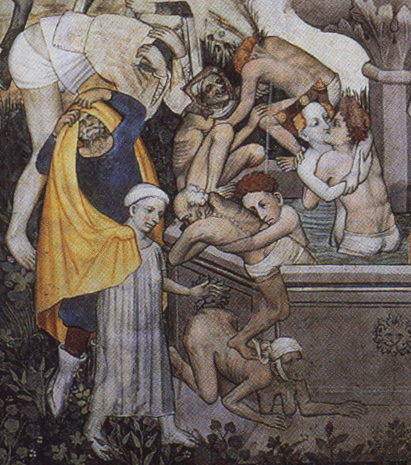
See the baths linkspage for examples of a smock worn by women who worked in bathhouses.
See also Extant Italian Women's Shifts (Camicie) for several examples from the 16th and 17th centuries.
- Chemise of Isabelle (d. 1270), sister of Louis IX of France
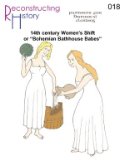
- A 14th century sleeveless chemise, and its pattern
- Susannah led to her execution (The Hague, MMW, 10 B 23, fol. 260v), 1372
- Death of the unfaithful woman, Guiron le Courtois (BNF NAF 5243, fol. 90r), c. 1370-1380
- Lancelot and the seductive damsel, Lancelot du Lac (BNF Fr. 118, fol. 299v), beginning of the 15th century
- Lancelot challenged by a knight (fol. 412v) and Lancelot rescues a damsel (fol. 413v), Lancelot du Lac (BNF Fr. 119), beginning of the 15th century
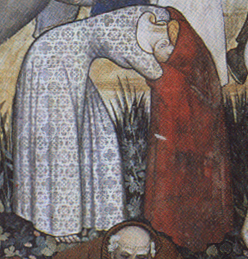
- Dionysius I humiliates the women of Locri (fol. 98v) and Torture of Agrippina the Young (fol. 196) in De casibus (BNF Fr. 226), first quarter of the 15th century
- Agrippina (fol. 139) and Epicharis (fol. 141v), De mulieribus claris (British Library Royal 20 C V), first quarter of the 15th century
- A woman and another woman by the Fountain of Youth, from a fresco c. 1411 at the Castello di Manta
- Niccolosa (fol. 253v) and Gemmata (fol. 264v), The Decameron (BNF Fr. 239), second quarter of the 15th century
- Decameron (BnF Arsenal 5070, fols. 347v and 387r), 1432
- The Birth of Mary from an altarpiece at Kloster Neuburg, c. 1438-1440
- Sulpicia (fol. 98v), Agrippina (fol. 107), and Epicharis (fol. 109), De mulieribus claris (British Library Royal 16 G V), c. 1440
- Jason and Medea put their clothes on, The Trojan War (ÖNB 2773, fol. 18v), c. 1445-1450
- St. Anne in The Birth of Mary, c. 1470
- The Birth of St. Nicholas from the frescoes at the Church of St. Nicholas in Klerant by Leonhard von Brixen-Umkreis, c. 1475-1485
- Marriage, Der Renner (PML M.763, fol. 141r), last quarter of the 15th century
- Illustration from the Roman de Tristan (Musée Condé 645, fol. 101r), c. 1479-1480
- Bohort helps Benigne (BNF Fr. 111, fol. 139), c. 1480
- The second part of the story of Patient Griselda, c. 1493-1500
- Woman's long shirt in embroidered linen with lace, c. 1550-1600
- Manchester 2003.76, a linen shift with blackwork embroidery, c. 1575-1585
- V&A T.113 to 118-1997, a linen shift with blackwork embroidery, c. 1575-1585
- Met 41.64, an Italian linen blouse embroidered in silk and metal thread, late 16th century; also here
- National Trust 135702, a linen shift with drawn thread borders worn by Mary, Queen of Scots when she was executed in 1587
- Met 10.124.1, an Italian linen undershirt with silk and metal thread embroidery, 16th century; also here
- Whitworth T.11015, an embroidered linen smock, c. 1600
- MFA 38.1737, an Italian linen smock with silk embroidery and silk bobbin lace, c. 1600; also here
- V&A T.770-1919, an Italian linen shift with embroidered floral sprigs in silk and woven braid trimming, 1600s
- V&A T.326-1982, an English smock in linen embroidered with silk, c. 1600-1620
- V&A 226-1893, an Italian smock with lace ribbon and embroidered with colored silks, 1600s
|