|
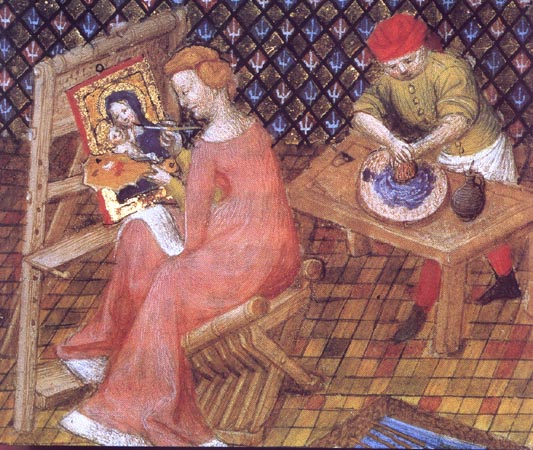
A demonstration of some of the tools used by limners and illuminators, via illustrations of them at work and relevant examples of the tools in museum collections and other websites with related artifacts.
Notice the development of different types of easels, palettes, and paintbrushes.
(For illuminators and book-illustrators, see this linkspage.)
See also Cennini's Libro dell' Arte, and also these links.
- A painter (with a scrivener), Reiner Musterbuch (ÖNB 507, fol. 2v), c. 1200-1220
- A painter from a fresco at Taufers im Münstertal, c. 1218-1230
- Paint palettes made from oyster shells, London, 13th century
- Painting an image in a shrine (fol. 209v) and the devil tries to distract St. Dunstan (fol. 248r), the Smithfield Decretals (Brit. Lib. Royal 10 E IV), c. 1300-1340
- A monk painting a fresco of the Virgin Mary; his ladder is broken by the devil but he is then rescued by the Virgin, the Queen Mary Psalter (British Library Royal 2 B VII, fol. 211r), c. 1310-1320
He þat portrayeþ ymages and liknesses of þinges ben y-cleped peyntours … Peyntours draweth first lynes and liknesses of þe ymage þat schal be peynted and peynteþ þanne with dyuers colours. De proprietatibus rerum
(British Library MS Add. 27944) - Man mixing colored paint, Omne Bonum (British Library MS Royal 6 E VI, fol. 329), 1360-1375
- Timarete (fol. 86r), Eirene (fol. 92r), and Iaia (fol. 100v), De mulieribus claris (BNF Fr. 598), beginning of the 15th century
- Painters at work, Tafel van den Kersten Ghelove (PML M.691, fol. 90r), c. 1405-1410
- Timarete (fol. 68v) and Irene (fol. 73v), De mulieribus claris (British Library Royal 16 G V), early 15th century
- Timarete (with an assistant grinding pigment) in a 15th century illustration from De mulieribus claris
- The instruction of the young, Aristotle's Politics, Ethics, and Economics (BNF Fr. 22500, fol. 248), 15th century
- Two men paint a house while a third mixes paint, Bible historiale (PML M.394, fol. 145r), first quarter of the 15th century
- Timarete (fol. 90) and Irene (fol. 96), De mulieribus claris (British Library Royal 20 C V), first quarter of the 15th century
- St. Luke, prayer book (PML M.944, fol. 75v), c. 1420
- St. Luke, the Hours of William Porter (PML M.105, fol. 35r), c. 1420-1425
I know a woman today, named Anastasia, who is so learned and skilled in painting manuscript borders and miniature backgrounds that one cannot find an artisan in all the city of Paris – where the best in the world are found – who can surpass her, nor who can paint flowers and details as delicately as she does, nor whose work is more highly esteemed, no matter how rich or precious the book is. People cannot stop talking about her. And I know this from experience, for she has executed several things for me, which stand out among the ornamental borders of the great masters. Christine de Pisan, Le livre de la Cité des Dames - Forese da Rabatta and Giotto, The Decameron (BNF Fr. 239, fol. 174v), second quarter of the 15th century
- St. Luke, a book of hours (PML M.453, fol. 14v), c. 1425-1430
- St. Luke by Rogier van der Weyden, 1435
- Irene (fol. 73v) and Thamar (fol. 68v), De mulieribus claris (British Library Royal 16 G V), c. 1440
- A copyist-illuminator at work, Mare historiarum (BNF Latin 4915, fol. 1), 1447-1455; see Copistes, enlumineurs et mécènes for discussion of the various details
- St. Luke, The Hours of Philip of Burgundy (KB 76 F 2, fol. 255r), c. 1450-1460
- St. Luke, The Hours of Jacques de Brégilles (British Library Yates Thompson 4, fol. 14v), c. 1460
- Euphranor paints a statue, Facta et dicta memorabilia (BNF Fr. 289, fol. 395), second half of the 15th century
- St. Luke, the Hours of Anne of France (PML M.677, fol. 29v), 1473
- The Children of Mercury, Biblia Pauperum (ÖNB 3085, fol. 25r), 1475
- Mercury and His Children, the Wolfegg Housebook, c. 1475-1485
- St. Luke by Gabriel Maelesskircher, 1478
- Color, Livre des propriétés des choses (BNF Fr. 9140, fol. 361v), 1480
- St. Luke in The Golden Legend (BNF Fr. 245, fol. 141), c. 1480-1490
- St. Luke, the Hours of Louis de Laval (BNF Latin 920, fol. 32v)
- St. Luke in a book of hours (Bibl. Mazarine, MS 0483, fol. 013v), c. 1490-1499
- Zeuxis painting nude models, Roman de la Rose (British Library Harley 4425, fol. 142), c. 1490-1500
- St. Luke by Vranck van der Stock
- St. Luke in a book of hours (KB 135 G 19, fol. 27v), c. 1495
- Timarete, De mulieribus claris (BNF Fr. 599, fol. 22v), 15th-16th centuries
- St. Luke, a book of hours (PML M.390, fol. 15r), c. 1500
- St. Luke in the Hours of Joanna I of Castile (British Library Add 35313, fol. 12v), c. 1500
- Portrait of a young artist, c. 1500
- Laodamia, Ovid's Heroides (BNF Fr. 874, fol. 105), beginning of the 16th century
- St. Luke, book of hours (Douce 112, fol. 23v), beginning of the 16th century
- St. Luke, book of hours (Douce 256, fol. 15r), beginning of the 16th century
- Niklaß Kerner, Mendel Hausbuch (Amb. 317.2, fol. 123v), 1505
- The wise man and the fool in a book of love poetry (British Library MS Stowe 955, fol. 9*r), early 16th century
- St. Luke in a book of hours (MMW 10 E 3, fol. 19v), c. 1500-1525
- St. Luke, a book of hours (PML M.250, fol. 17r), c. 1500-1510
- The Miracle of St. Francis of Paola, 16th century
- St. Luke by Niklaus Manuel
- St. Luke, Gospels of Luke and John (British Library Royal 1 E V, fol. 3), after 1519
- St. Luke, a book of hours (PML M.632, fol. 15r), c. 1520
- Saint Luke, c. 1520
- St. Luke in a book of hours (MMW 10 F 33, fol. 15v) by Jehan de Luc, 1524
- St. Luke by Quentin Massys, c. 1530
- St. Luke by Maerten van Heemskerck, 1532
- St. Luke by Pieter Coecke van Aelst, c. 1535-1540
- St. Luke by Maerten van Heemskerck, c. 1545
- Self-portrait of Caterina van Hemessen, 1548
- St. Luke by Maerten van Heemskerck, 1550-1553
- Self-portrait of Sofonisba Anguissola, c. 1556
- Bernardino Campi Painting Sofonisba Anguissola by Sofonisba Anguissola, 1557-1559
- Self-portrait of Anthonis Mor, 1558
- A sheet with a number of studies by Virgil Solis
- Landscape with ruins and a painter by Virgil Solis
- St. Luke by Giorgio Vasari, after 1565
- St. Luke by El Greco, before 1567
- The Painter, Das Ständebuch, 1568
- A painter painting the portrait of a seated lady, 16th century
- A young painter, seen from behind by Annibale Caracci, c. 1575-1609
- Young painter at an easel by Annibale Caracci, c. 1580
- Oil colors: The famous Master Eyckius discovered oil as a convenience for painters, New discoveries; the sciences, inventions, and discoveries of the Middle Ages and the Renaissance as represented in 24 engravings issued in the early 1580's by Stradanus
- Otto Venius painting, surrounded by his family, 1584
- Portrait of the artist and his family by Jacob Willemsz Delff, c. 1590
- Self-portrait of Cornelis Cornelisz van Haarlem
- The unfortunate painter and his family by Marcus Gheeraerts
- Painter, wearing a cap with a narrow edge, painting, sitting at his easel
- Young man seated, holding a palette by Jacopo da Empoli
- St. Luke by Marten de Vos, 1602
- Portrait of Jorge Manuel Theotokopoulos by El Greco, c. 1603
|