|
Images showing the use of garters on various types of hose.
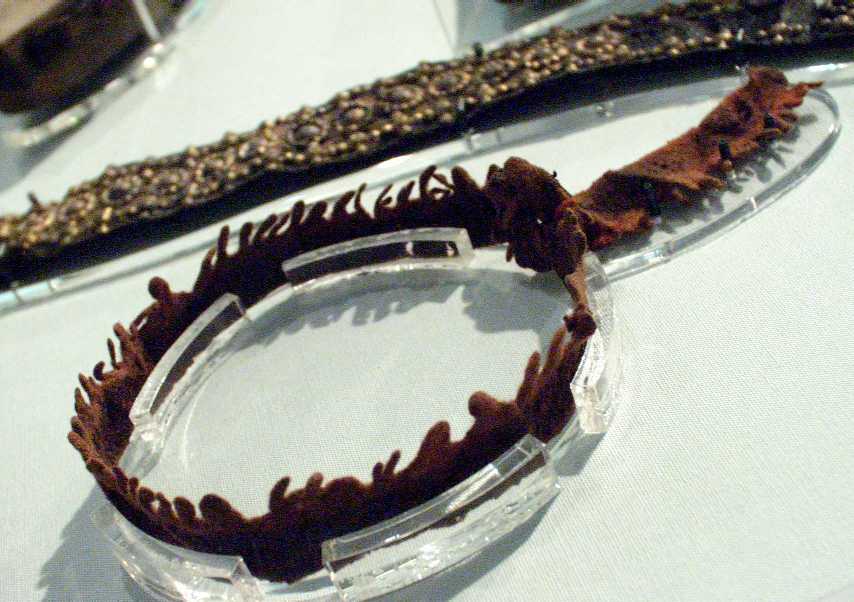
- Buckles and tips from the garters found in the tomb of Queen Aregonde, c. 570
- Garter, London, early 14th century
- Sword-fighting, Corpus iuris civilis (UBG 32, fol. 91v), first half of the 14th century
- A man, Sermons (UBG 730, fol. 49v), first half of the 14th century
- Marginal illustrations on fols. 60r,
87r, 158v, 170v, and an archer,
the Luttrell Psalter (British Library Add. 42130, fol. 170v), c. 1325-1335
Byneþe here hamme upon a hose gray, y-bounde is žat dame wyþ a garter grey, here legges faste to ty3te here hose “Þo oure lord god …”, PML M.957, c. 1400 - Killing an adulterer, Concordantiae caritatis (SBL 151, fol. 244v), c. 1349-1351
- The rape of Dinah, Egerton Genesis Picture Book (British Library Egerton 1894, fol. 17), third quarter of the 14th century
- The greeting of Willehalm and Rennewart, Willehalm (ÖNB 2643, fol. 185r), 1387
- Badge: a hunter, late 14th century
- Fols. 3v, 4r, 4v, 5r, 5v, 6r, 6v, 7r, 7v, 8v, 9r, 9v, 10v, 11r, and 11v,
Il fior di battaglia / Fiore dei Liberi (PML M.383), early 15th century
- Tedaldo returns to Florence disguised as a pilgrim in the Decameron (BNF Arsenal 5070, fol. 120r), 1432
- The drunkenness of Noah, Weltchronik (ÖNB 2823, fol. 21r), 1463
And the comouns weren no wolen, but yf it be a powvere cote undir thair uttermest garnement, made of grete caunvas, and callid a frokke. Thair hausyn beth of lyke caunvas, and passyn not thair kne, wherfore thai beth gartered and ther theis bare. Thair wyfes and childeren gone barefote; thai mowe in non otherwyse leve. Sir John Forescue’s description of French customs, The Governance of England, c. 1475 - A woman (the letter R on the third row), the Hours of Charles d’Angoulême (BNF Latin 1173, fol. 52r), c. 1475-1500
- A suspicious husband maltreats his wife, Le roman de la rose (Douce 195, fol. 66v), end of the 15th century
- The stoning of St. Stephen, 1502
- Flight into Egypt by Albrecht Dürer, 1503-1504
- Nativity, 1505
- The bearing of the Cross, a prayerbook (ÖNB 3257, fol. 20v), 1505
- The martyrdom of St. Catherine on an alterpiece at Poniky in Slovakia, 1512
|